Every construction site and every farm begins with the same unseen question: what is actually in the ground? Soil can look perfectly healthy and still hold salts that corrode steel, sulphates that attack concrete, or nutrient imbalances that quietly cut crop yield. Chemical analysis of soil answers that question with measured numbers instead of guesswork.
At RK Soil Testing LLP, our laboratory in Gomti Nagar, Lucknow, has supported residential, commercial, industrial and infrastructure projects across Uttar Pradesh for over 25 years. This guide explains, in plain language, what soil chemical analysis involves, which parameters matter, how testing is carried out, and how to use the results.
What Is Chemical Analysis of Soil?
Chemical analysis of soil is the laboratory measurement of the chemical properties and chemical constituents of a soil sample. Where physical tests such as grain size, Atterberg limits or compaction describe how soil behaves mechanically, chemical tests describe what the soil is made of and how it will react with water, concrete, steel, plants and the environment.
Typical results include the soil’s acidity or alkalinity (pH), its salt content (electrical conductivity), soluble sulphates and chlorides, organic matter, carbonate content, cation exchange capacity, available nutrients, and in some cases heavy metals or other contaminants.
Why Chemical Analysis of Soil Is Important
The results serve different purposes depending on who is asking.
For civil and structural engineers: Foundations sit in direct, permanent contact with soil and groundwater. Aggressive chemicals can shorten the life of concrete and reinforcement long before the structure reaches its design life. Knowing the chemistry in advance lets the designer choose the right cement type, concrete grade, cover and protective measures.
For farmers and agronomists: Crop performance depends on soil reaction, salinity and nutrient availability. A chemical report shows which nutrients are deficient, whether the soil is salt-affected, and how much amendment or fertiliser is actually needed, which prevents both under- and over-application.
For environmental and industrial projects: Factory sites, landfill areas and land being redeveloped may carry contamination. Chemical testing establishes a baseline and shows whether remediation is needed.
For compliance and documentation: Many project specifications, tenders and lender requirements ask for a chemical analysis report alongside the geotechnical investigation report.
Key Parameters Tested in Soil Chemical Analysis
1. pH Value
pH measures how acidic or alkaline the soil is. Most crops grow best in a near-neutral range, and extreme values reduce nutrient availability. In construction, very low pH (acidic) soil or groundwater can attack concrete, while high alkalinity often signals salt-affected or sodic conditions, which are common in parts of the Indo-Gangetic plain.
2. Electrical Conductivity (EC) and Total Soluble Salts
EC indicates the concentration of dissolved salts. High EC stresses plants and can indicate corrosion risk for buried steel and reinforcement. It is one of the quickest indicators that a site needs closer chemical investigation.
3. Soluble Sulphates
Sulphates in soil or groundwater can react with the hydrated compounds in cement and cause expansion, cracking and loss of strength in concrete. This is why sulphate content is among the most requested chemical tests for foundations, piles, basements and underground tanks. Design codes, including IS 456, classify sulphate exposure so that cement type and mix can be selected accordingly.
4. Chlorides
Chlorides do not damage concrete directly, but they break down the protective film around reinforcement steel and start corrosion. Sites near saline groundwater, industrial effluent or de-icing and coastal influence need particular attention.
5. Organic Matter and Organic Carbon
Organic matter improves fertility and water retention in agricultural soil. In construction, however, high organic content is undesirable because it makes soil compressible, weak and prone to settlement, and it can interfere with cement hydration in stabilised soil.
6. Calcium Carbonate
Carbonate content affects soil structure, pH buffering and nutrient availability. It is relevant for agriculture and also helps characterise soils for road subgrade and stabilisation work.
7. Cation Exchange Capacity (CEC)
CEC describes the soil’s ability to hold and exchange positively charged nutrients such as calcium, magnesium, potassium and sodium. It is a good indicator of fertility and of clay activity.
8. Major and Micronutrients
For agricultural testing, the standard panel covers available nitrogen, phosphorus and potassium, secondary nutrients such as sulphur, and micronutrients such as zinc, iron, copper, manganese and boron. The Government of India’s Soil Health Card scheme uses a similar twelve-parameter set (N, P, K, S, Zn, Fe, Cu, Mn, B, pH, EC and organic carbon), so results can be read against widely understood benchmarks.
9. Heavy Metals and Contaminants
Where industrial activity, waste disposal or sewage irrigation is involved, tests for metals such as lead, cadmium, chromium, nickel or arsenic may be required. The exact list depends on the site history and the regulatory requirement.
How Soil Chemical Analysis Is Carried Out
A reliable result depends as much on the steps before the laboratory as on the instruments inside it.
Step 1: Planning the Sampling
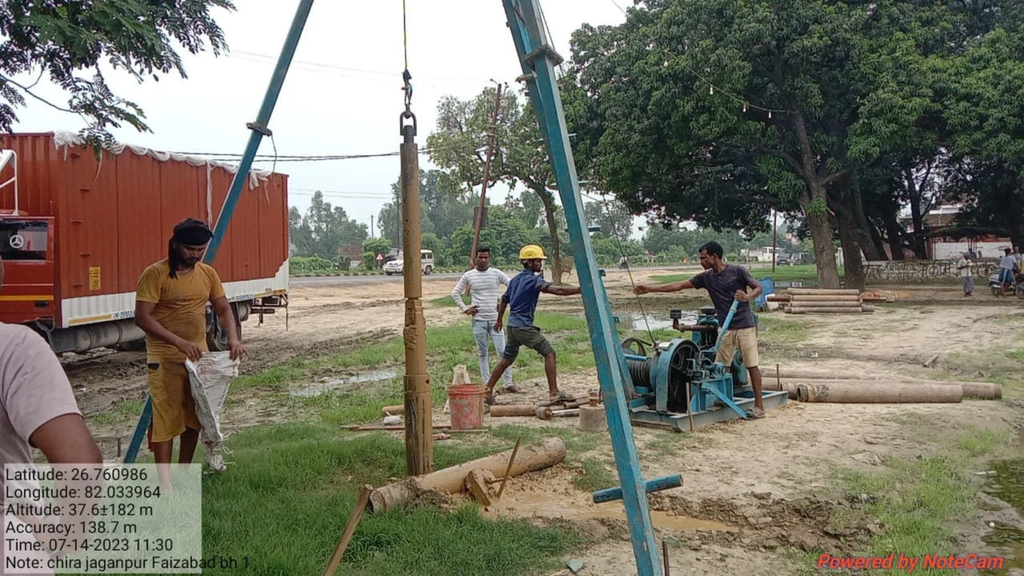
The purpose of the test decides the sampling plan. A foundation investigation samples at several depths, usually from boreholes or trial pits, because chemistry can change with depth and with the water table. An agricultural field is divided into uniform zones and sampled in a zigzag or grid pattern.
Step 2: Collecting Representative Samples
Samples are collected with clean tools, free from contamination by fertiliser, cement, oil or rust. Each sample is labelled with location, depth, date and collector, then sealed in clean bags or containers. Sample quantity should be adequate, since too little material limits the number of tests that can be run.
Step 3: Transport and Preparation
Samples are brought to the laboratory promptly. Moisture-sensitive samples are protected from drying or contamination. In the lab, the soil is air-dried where appropriate, crushed, sieved and homogenised so that the portion tested truly represents the whole sample.
Step 4: Extraction and Testing
Depending on the parameter, soil is mixed with distilled water or a chemical extractant in a defined ratio, shaken, filtered and then analysed. Common techniques include:
- Potentiometric measurement for pH and EC with calibrated meters
- Gravimetric and turbidimetric methods for soluble sulphate
- Titration (for example argentometric titration) for chloride
- Wet oxidation methods for organic carbon
- Spectrophotometry, flame photometry or atomic absorption spectroscopy for nutrients and metals
Standard procedures follow recognised references such as the relevant parts of the IS 2720 series for soils (covering parameters like pH, soluble sulphate and organic matter), alongside accepted agricultural and environmental methods.
Step 5: Quality Control and Reporting
Good laboratories run calibration checks, blanks and, where appropriate, duplicate samples to confirm accuracy. The final report states the sample identification, the method used, the results with units, and a clear reading of what they mean for the intended use.
Understanding Your Soil Test Report
A report is only useful if it can be acted on. As a practical guide:
- For foundations: Compare sulphate and chloride values against the exposure classes in the relevant design code, then discuss cement type, concrete grade, cover to reinforcement and any protective coating with your structural designer.
- For roads and subgrade: Review organic content, salts and pH together with the physical test results before deciding on stabilisation.
- For farming: Match nutrient and pH results to your crop and seek local agronomy advice on amendments such as gypsum for sodic soil, lime for acidic soil, or targeted fertiliser.
- For redevelopment sites: Compare contaminant levels with applicable regulatory limits before deciding on clearance or remediation.
No single number tells the whole story. Chemical results are most useful when read together with the geotechnical findings, groundwater conditions and the site’s history.
Common Mistakes That Lead to Wrong Results
- Testing one sample for a large or variable site. One sample cannot represent different soil layers or different corners of a plot.
- Sampling from the surface only. Foundations and piles interact with deeper soil and groundwater, so depth matters.
- Using contaminated tools or containers. Even small traces of fertiliser, cement or salt skew results.
- Long delays before testing. Some parameters change with time, so prompt delivery to the lab protects accuracy.
- Ignoring groundwater. Soil and water chemistry are linked; for many projects water analysis should accompany soil analysis.
- Treating the report as a formality. The value lies in changing the design or management decision, not in filing the paper.
When Should You Get Soil Chemical Analysis Done?
- Before designing foundations, basements, piles or underground structures
- When the site is near industry, a drain, a salt-affected area or a former landfill
- Before laying roads, pavements, canals or embankments
- Before starting or changing cultivation on a plot
- When concrete, plaster or steel at an existing structure shows unexplained damage
- When a project specification or authority asks for it
Testing early is almost always cheaper than repairing a structure or a failed crop later.
Why Choose RK Soil Testing LLP for Soil Chemical Analysis
RK Soil Testing LLP provides geotechnical investigation, building material testing, topographical surveys and chemical analysis from our Lucknow laboratory. Our work spans residential, commercial, industrial and infrastructure projects across Uttar Pradesh, and our team handles on-site sampling and field investigation as well as laboratory testing.
What you can expect from us:
- Sampling guidance suited to your project, whether it is a foundation, road or field
- Testing carried out with standard procedures and quality-controlled methods
- Clear reports that explain results in practical terms, not just tables of numbers
- Technical recommendations that connect the chemical findings to your design or farming decision
- Combined geotechnical and chemical investigation, so you get one coordinated set of findings
You can read more about our chemical analysis services and our geotechnical investigation work, or contact our team to discuss your site.
Frequently Asked Questions
What is included in a standard soil chemical analysis? The scope depends on the purpose. For construction it usually includes pH, EC or total soluble salts, sulphates, chlorides and sometimes organic matter and carbonates. For agriculture it adds available nutrients and organic carbon.
How much soil sample is needed? The quantity depends on the number of tests. It is best to confirm with the laboratory before collecting, since a sample that is too small limits the tests that can be performed.
How long does a soil chemical analysis take? Time depends on the tests and the number of samples. Simple parameters can be reported quickly, while a broad panel takes longer. Ask the laboratory for a committed timeline when you submit samples.
Can soil chemical analysis predict concrete damage? It identifies risk factors such as sulphates and chlorides so the design can account for them. Actual durability also depends on concrete quality, cover, drainage and exposure conditions.
Is soil testing needed for a small residential plot? It is advisable, particularly if the area has high groundwater, salt-affected soil, or known problems nearby. The cost is small compared with the cost of foundation repair.
Should I test soil and water together? Often yes. Groundwater carries many of the same chemicals and can transport them to your foundation, so a combined view is more reliable.
Conclusion
Chemical analysis of soil turns an invisible risk into a measurable, manageable one. For builders it protects the durability of foundations and reinforcement; for farmers it guides fertility decisions; for developers and industries it supports safe, compliant use of land. The most valuable results come from careful sampling, standard methods, and an expert who can explain what the numbers mean for your specific project.
If you are planning a project in Lucknow or elsewhere in Uttar Pradesh, RK Soil Testing LLP can help. Call +91-9336177365 or +91-63942 31419, or visit our laboratory at 1/416 Vastu Khand, Gomti Nagar, Lucknow.
Disclaimer: This article is for general information. Site-specific decisions should be based on a laboratory report and advice from a qualified engineer or agronomist.
