
Pile Load Testing: Types, Procedure, Importance, and Applications in Foundation Engineering
Pile Load Testing is an essential geotechnical investigation used to evaluate the load-bearing capacity and settlement behaviour of pile foundations. It helps engineers determine whether piles can safely transfer structural loads to the underlying soil or rock. Pile load testing plays a vital role in the construction of residential buildings, commercial complexes, bridges, industrial structures, and large infrastructure projects.
RK Soil Lab provides soil testing and geotechnical investigation services to support safe, reliable, and durable construction projects. Pile load testing is an important part of foundation assessment, helping engineers verify pile performance and make informed foundation design decisions.
What Is Pile Load Testing?
Pile Load Testing is a field test conducted to determine the load-carrying capacity and settlement characteristics of a pile foundation. During the test, a predetermined load is applied to a pile, and its movement or settlement is measured using suitable instruments.
The results help geotechnical engineers assess the pile’s response under applied loads and compare its performance with the design requirements. Depending on the project specifications, pile load testing may be performed on working piles or test piles.
The testing procedure and acceptance criteria should follow the applicable project specifications and relevant standards, such as IS 2911 (Part 4), where applicable.
Importance of Pile Load Testing in Construction
Pile foundations are commonly used where shallow foundations cannot provide sufficient bearing capacity or where settlement must be controlled. Pile load testing helps verify foundation performance before or during construction.
Key benefits include:
-
Verification of Load Capacity: Evaluates the pile’s response to applied loads and helps verify design assumptions.
-
Settlement Assessment: Measures pile displacement under different loading stages.
-
Foundation Safety: Provides useful evidence for assessing foundation performance.
-
Quality Control: Helps identify discrepancies between expected and observed pile behaviour.
-
Design Validation: Supports engineers in evaluating pile design assumptions and construction quality.
-
Cost Management: Helps reduce the risk of expensive foundation-related problems when incorporated into an appropriate testing programme.
Types of Pile Load Testing
1. Initial Load Test
An initial load test is generally conducted on a test pile before or during the early stages of foundation construction. It helps establish the pile’s load-settlement behaviour and evaluate the suitability of the proposed pile design.
2. Routine Load Test
A routine load test is performed on selected working piles to assess whether their performance meets the specified requirements. The number and selection of piles depend on the applicable standards and project specifications.
3. Vertical Compression Load Test
This test evaluates a pile’s response to downward vertical loading. It is widely used to assess the compressive load capacity and settlement characteristics of pile foundations.
4. Lateral Load Test
A lateral load test evaluates how a pile responds to horizontal forces. It is particularly relevant for structures such as bridges, retaining systems, towers, and foundations subjected to wind or other lateral loads.
5. Pull-Out or Uplift Load Test
An uplift load test evaluates the pile’s resistance to upward forces. It may be required for structures where wind, buoyancy, or other forces can create uplift loads.
Pile Load Testing Procedure
The pile load testing procedure generally involves the following steps:
Step 1: Site Preparation
The test location is inspected, and the pile is prepared according to the approved testing methodology.
Step 2: Test Setup Installation
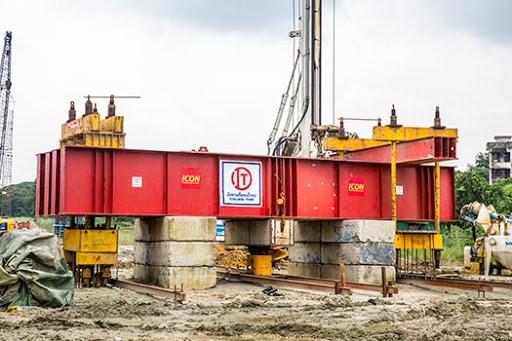
A suitable loading arrangement, reaction system, hydraulic jack, calibrated load-measuring equipment, and settlement-measuring instruments are installed.
Step 3: Initial Readings
Initial settlement and reference readings are recorded before the application of load.
Step 4: Application of Load
The load is applied in predetermined increments according to the approved test procedure.
Step 5: Settlement Measurement
Pile movement is measured at specified intervals during loading and unloading, as required by the test method.
Step 6: Unloading and Recovery Readings
The load is released according to the procedure, and residual settlement or recovery is recorded where required.
Step 7: Data Analysis and Reporting
The measured load and displacement data are analysed. A load-settlement curve is prepared, and the findings are compared with the relevant acceptance criteria.
Equipment Used for Pile Load Testing
Common equipment used during pile load testing includes:
-
Hydraulic jack and pump
-
Calibrated load cell or suitable load-measuring arrangement
-
Reaction frame, kentledge, or another approved reaction system
-
Dial gauges or displacement transducers
-
Independent reference beams and supports
-
Data recording instruments
-
Safety equipment and accessories
The equipment and arrangement depend on the type of test, anticipated loads, site conditions, and applicable standards.
Applications of Pile Load Testing
Pile load testing is commonly used in:
-
Residential and commercial building projects
-
Bridges, flyovers, and highway infrastructure
-
Industrial plants and warehouses
-
High-rise buildings
-
Metro and railway infrastructure
-
Power plants and transmission structures
-
Marine and waterfront structures
-
Major civil engineering and infrastructure developments
Why Is Pile Load Testing Important in Lucknow?
Lucknow has ongoing residential, commercial, institutional, and infrastructure development. Depending on the site conditions, structural loading, groundwater conditions, and geotechnical investigation findings, deep foundations may be required for certain projects.
Pile load testing helps project teams evaluate actual pile behaviour and verify compliance with design and project requirements. Builders, developers, consultants, and contractors should select an appropriate testing programme based on the foundation design, soil investigation report, and applicable standards.
RK Soil Lab supports construction and geotechnical testing requirements, helping project teams make informed decisions about foundation performance.
Why Choose RK Soil Lab?
RK Soil Lab focuses on supporting construction projects through soil testing and geotechnical investigation services. Reliable testing, appropriate procedures, accurate observations, and clear technical reporting are important for evaluating foundation performance.
For pile load testing or other geotechnical investigation requirements, project owners and construction professionals should discuss the project location, pile details, design loads, and applicable specifications with the testing team before scheduling the work.
