
Rebound Hammer Testing:
Rebound Hammer Testing is a widely used non-destructive testing (NDT) method for assessing the surface hardness and uniformity of hardened concrete. It helps engineers and construction professionals evaluate concrete quality without causing significant damage to the structure.
The test is commonly performed on concrete buildings, bridges, columns, beams, slabs, retaining walls, and other reinforced concrete structures. It provides useful information about variations in concrete quality and helps identify areas that may require further investigation.
RK Soil Lab provides construction material testing and engineering testing services to support informed decisions throughout construction and infrastructure projects.
What Is a Rebound Hammer Test?
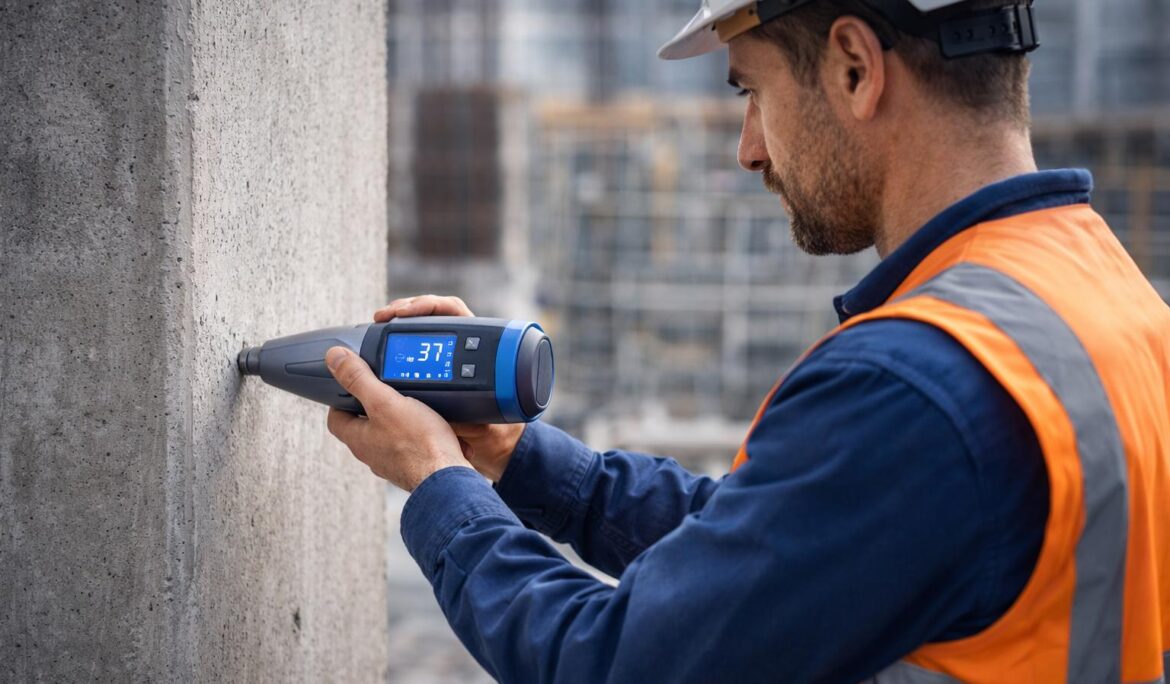
The Rebound Hammer Test, also known as the Schmidt Hammer Test, is a non-destructive testing technique used to assess the surface hardness of concrete. The instrument works by releasing a spring-controlled mass against a plunger placed on the concrete surface and measuring the rebound response.
The measured rebound number is influenced by the hardness of the concrete surface and other factors, including moisture condition, surface finish, concrete age, aggregate type, and testing orientation.
A rebound hammer test is useful for comparing the relative quality of concrete in different locations. However, the rebound number alone does not provide a definitive measurement of compressive strength. Any estimate of compressive strength should be based on an appropriate correlation established for the concrete under investigation.
Objectives of Rebound Hammer Testing
The main objectives of rebound hammer testing include:
-
Assessing the relative surface hardness of hardened concrete.
-
Evaluating uniformity in concrete quality across a structure.
-
Identifying areas that may need further inspection or testing.
-
Supporting the assessment of existing concrete structures.
-
Helping engineers plan additional investigations where necessary.
-
Monitoring changes in concrete surface properties over time.
Rebound Hammer Testing Procedure
Proper testing procedures are essential for obtaining consistent and meaningful results. The test should be carried out by trained personnel following the applicable testing standard and project requirements.
1. Selection of the Test Area
The engineer selects suitable locations on the concrete surface. Areas with loose material, visible damage, coatings, or unsuitable surface conditions should be avoided or prepared appropriately.
2. Surface Preparation
The concrete surface is cleaned and, where necessary, smoothed using a suitable abrasive stone. The test area should be free from loose particles and surface irregularities that could affect the readings.
3. Instrument Inspection
The rebound hammer is inspected before testing. Its condition and calibration or verification status should be checked in accordance with the manufacturer’s instructions and the applicable standard.
4. Performing the Test
The plunger is held firmly against the concrete surface, and the instrument is operated according to the manufacturer’s instructions. The hammer should be positioned in the required testing orientation, such as horizontal, vertical upward, or vertical downward.
5. Recording Rebound Readings
Multiple readings are taken at appropriate, separated impact points within the selected test area. Readings affected by unsuitable impacts or obvious surface defects are handled according to the applicable testing procedure.
6. Evaluating the Results
The readings are reviewed and evaluated according to the relevant standard. The engineer considers the testing orientation, surface condition, concrete characteristics, and other influencing factors before interpreting the results.
7. Reporting
The final report records the test locations, instrument details, testing orientation, individual readings, evaluated results, observed conditions, and relevant limitations. Where compressive strength estimates are required, the basis of the correlation should be documented.
Applications of Rebound Hammer Testing
Rebound hammer testing is used in various construction and infrastructure applications.
Existing Building Assessment
The test helps assess relative variations in surface hardness across concrete elements in residential, commercial, and industrial buildings.
Bridge and Infrastructure Inspection
Engineers may use rebound hammer testing as part of a wider inspection programme for bridges, flyovers, culverts, and other reinforced concrete infrastructure.
Concrete Quality Assessment
The method helps compare concrete surface characteristics across different locations and identify areas requiring further investigation.
Structural Condition Surveys
Rebound hammer testing can contribute to condition assessments of older structures, particularly when combined with visual inspection and other appropriate testing methods.
Construction Quality Control
Where specified in a quality-control plan, the test can support checks on concrete uniformity and help identify areas for additional evaluation.
Advantages of Rebound Hammer Testing
Rebound hammer testing offers several practical advantages:
-
Non-destructive method: It generally causes little to no visible damage to the tested surface when properly performed.
-
Quick assessment: Multiple locations can be tested in a relatively short time.
-
Portable equipment: The instrument can be used at many accessible construction sites.
-
Comparative evaluation: It helps identify relative variations in concrete surface hardness.
-
Cost-effective screening: It can support decisions about where more detailed testing may be appropriate.
-
Useful for existing structures: It can be performed on many hardened concrete elements without extracting a core.
Limitations of Rebound Hammer Testing
Although the test is useful, it has important limitations.
Rebound numbers can be affected by surface moisture, carbonation, aggregate type, concrete age, surface texture, impact direction, and other conditions. Consequently, results from different structures or concrete mixes should not be compared without considering these factors.
The test primarily assesses surface hardness and should not be used alone to establish the actual compressive strength of concrete or to certify the structural safety of a building.
Where reliable strength assessment is necessary, engineers may recommend supplementary methods, such as concrete core testing or other suitable non-destructive tests, based on the structure’s condition and project requirements.
Relevant Standards for Rebound Hammer Testing
In India, rebound hammer testing of hardened concrete is commonly associated with IS 13311 (Part 2):1992, which addresses the use of the rebound hammer for non-destructive testing of concrete.
The applicable edition, any subsequent amendments, and project-specific requirements should be verified before testing. The testing procedure and interpretation must follow the relevant standard and the instrument manufacturer’s guidance.
Why Choose RK Soil Lab?
RK Soil Lab supports construction and infrastructure projects with engineering and construction material testing services. Reliable testing practices, appropriate procedures, and clear reporting help engineers, contractors, builders, and project stakeholders make better-informed decisions.
For concrete quality assessment, the appropriate testing method depends on the project’s objectives, structural condition, and applicable specifications. Rebound hammer testing can form one part of a broader investigation when interpreted alongside other relevant evidence.
Contact RK Soil Lab to discuss your construction testing requirements and determine the appropriate testing approach for your project.
